
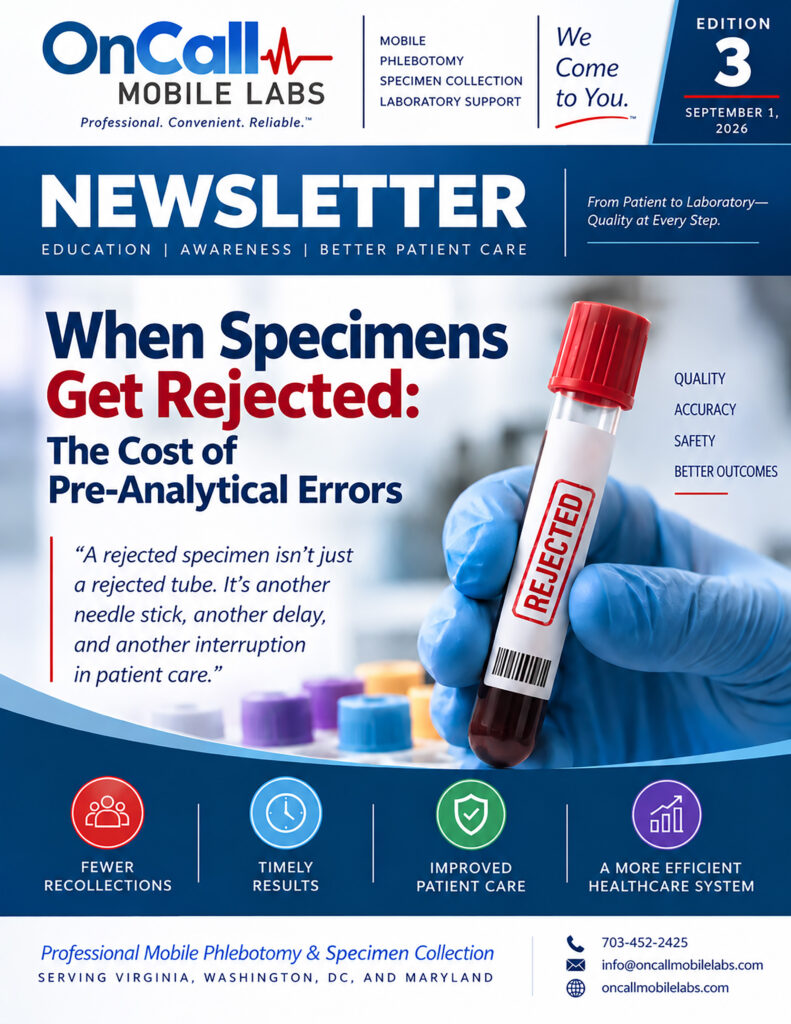
“A rejected specimen isn’t just a rejected tube. It’s another needle stick, another delay, and another interruption in patient care.”
Laboratory testing doesn’t begin when a specimen reaches the laboratory. Quality begins with the patient, the collection, and everything that happens to the specimen before testing.
A blood draw can appear completely successful, yet the specimen may still be unsuitable for testing because of an error during identification, collection, processing, storage, or transportation. These are commonly referred to as pre-analytical errors.
At OnCall Mobile Labs, we believe preventing these errors is an essential part of professional specimen collection—especially when caring for elderly, homebound, medically fragile, and difficult-draw patients.
What Is a Pre-Analytical Error?
The laboratory testing process can generally be divided into three phases: pre-analytical, analytical, and post-analytical.
The pre-analytical phase includes many of the steps that occur before the specimen is actually tested:
Patient identification → Test preparation → Specimen collection → Labeling → Processing → Storage → Transportation → Laboratory receipt
An error at any of these stages can compromise specimen integrity and may result in the laboratory rejecting the specimen or reporting results that require further investigation.
This is why phlebotomy is about much more than successfully getting blood into a tube.
Why Do Laboratories Reject Specimens?
Requirements vary according to the test and receiving laboratory, but several common problems can make a specimen unacceptable.
1. Hemolysis
Hemolysis occurs when red blood cells rupture and release their intracellular contents into the surrounding serum or plasma.
Collection technique, excessive mechanical stress, improper handling, transportation conditions, and other factors can contribute to hemolysis.
Depending on the degree of hemolysis and the test being performed, laboratory results may be affected and recollection may be necessary.
2. Clotted Anticoagulated Specimens
Certain tests require anticoagulated whole blood or plasma. If a specimen that should remain anticoagulated develops clots, it may no longer be suitable for testing.
Proper collection volume and appropriate mixing of additive tubes immediately after collection are important steps in preventing clot formation.
3. Insufficient Quantity
Laboratories require enough specimen to perform the ordered testing.
Some collection tubes also require an appropriate blood-to-additive ratio. This is particularly important for certain coagulation testing.
An underfilled tube isn’t necessarily just a smaller specimen—it can be an unsuitable specimen depending on the test and collection system.
4. Wrong Tube or Container
Different tests require different specimen types and additives.
A test may require:
- EDTA whole blood
- Citrated plasma
- Heparinized plasma
- Serum
- Urine
- A sterile container
- A specialized collection kit
Collecting a specimen into the wrong tube or container can make it unacceptable before it ever reaches the laboratory analyzer.
5. Patient Identification and Labeling Errors
Correct identification is one of the most important responsibilities in specimen collection.
An excellent specimen collected from the wrong patient—or labeled incorrectly—cannot provide a safe laboratory result.
Patient identifiers must be verified and specimens labeled according to the receiving laboratory’s requirements.
6. Delayed Processing
Some specimens have specific processing deadlines.
Depending on the test, serum or plasma may need to be centrifuged and separated from the cellular components within a defined period after collection.
Leaving certain specimens in contact with cells beyond the permitted timeframe can affect analyte stability and specimen quality.
7. Improper Centrifugation or Separation
Not every specimen should be centrifuged, and not every centrifuged specimen is handled the same way afterward.
Some tests require whole blood. Others require serum or plasma, which may need to be separated from the cellular components.
Understanding the test requirement before processing is critical.
8. Incorrect Temperature
Specimen stability can depend heavily on temperature.
Depending on the test, a specimen may need to remain at controlled room temperature, be refrigerated, or be frozen.
Improper temperature during storage or transportation may compromise the specimen.
9. Stability Problems
Every specimen has a period during which it remains suitable for the intended testing under specified conditions.
Even a properly collected specimen can become unsuitable if it is stored too long or transported under conditions outside the laboratory’s validated requirements.
What Happens When a Specimen Is Rejected?
It is easy to think of rejection as simply throwing away a tube and collecting another one.
For the patient and healthcare team, however, the consequences can extend much further.
A rejected specimen can mean:
- Another venipuncture for the patient
- Delayed laboratory results
- Delayed clinical decision-making
- Additional work for nurses and healthcare providers
- Another collection appointment
- Additional specimen transportation
- Increased operational costs
- Disruption to medication monitoring or treatment
- Frustration for patients, families, and healthcare staff
For a healthy patient with easy venous access, recollection may be an inconvenience.
For a medically fragile patient, it can be much more significant.
The Impact on Elderly and Difficult-Draw Patients
This issue is particularly important in nursing homes, assisted living communities, rehabilitation facilities, and home healthcare.
Older adults may have fragile veins, limited venous access, dehydration, chronic medical conditions, mobility limitations, or a history of repeated blood collections.
Some patients may also be receiving medications or treatments that make venipuncture more challenging.
When a preventable specimen error requires recollection, that resident must go through the procedure again.
For a difficult-draw patient, another blood collection can mean another search for a suitable vein, another needle stick, additional discomfort, and additional anxiety.
Preventing a recollection should therefore be considered part of good patient care—not merely laboratory efficiency.
Laboratory Quality Begins Before the Laboratory
Modern laboratories operate under rigorous quality standards, but laboratory professionals can only test the specimen they receive.
The quality of that specimen begins at the patient’s bedside.
The collector has an important responsibility to ensure that the specimen is:
From the correct patient.
Collected in the correct container.
Collected using appropriate technique.
Properly labeled.
Processed correctly.
Maintained under appropriate conditions.
Delivered within the required timeframe.
That is why experienced specimen collection matters.
A successful venipuncture is only the beginning.
How OnCall Mobile Labs Works to Prevent Specimen Rejection
At OnCall Mobile Labs, our approach begins before we arrive for the collection.
Whenever applicable, we review the requirements of the receiving laboratory and the specific tests ordered rather than assuming every specimen should be handled the same way.
Depending on the test, our review may include:
Test and Specimen Requirements
We determine the required specimen type, collection tube or container, minimum volume, additives, and any special collection instructions.
Patient Identification
Appropriate patient identifiers are verified against the laboratory order and required documentation before collection.
Proper Collection
The appropriate collection materials and techniques are used, including the proper order of draw when applicable.
Processing Requirements
We determine whether the specimen must remain as whole blood or requires centrifugation and separation into serum or plasma.
Processing Timeframe
If processing must occur within a specified period after collection, that requirement is identified before the specimen is collected.
Temperature Requirements
We determine whether the specimen should be maintained at controlled room temperature, refrigerated, frozen, or otherwise handled according to laboratory specifications.
Light Protection
For tests requiring protection from light, appropriate precautions are taken according to the receiving laboratory’s requirements.
Transportation and Delivery
Specimens are packaged, maintained under required conditions, and transported to the designated laboratory with attention to specimen stability and delivery deadlines.
Preparation Prevents Problem
One principle guides our specimen-management process:
Know the requirements before collecting the specimen.
Every laboratory has its own test directory, methodology, acceptance criteria, and specimen-handling requirements.
That is why OnCall Mobile Labs reviews the applicable receiving laboratory’s requirements for the ordered testing whenever necessary.
We want to know beforehand:
What do we collect?
How much do we collect?
What tube or container is required?
Does it remain whole blood?
Does it need to clot?
When should it be centrifuged?
Does serum or plasma need to be separated?
What temperature is required?
Does it need protection from light?
How long is it stable?
How quickly must it reach the laboratory?
Those questions should be answered before collection—not after a problem occurs.
Our Commitment: Right the First Time
At OnCall Mobile Labs, our goal is not simply to complete as many blood draws as possible.
Our goal is to provide professional specimen collection from patient to laboratory while helping reduce preventable pre-analytical errors, unnecessary recollections, and delays in patient care.
For nursing homes, assisted living communities, physician practices, research organizations, healthcare facilities, and individual patients, this means having a specimen collection partner who understands that what happens after the needle comes out matters just as much as the blood draw itself.
A rejected specimen isn’t just a rejected tube.
It’s another needle stick.
Another delay.
Another interruption in patient care.
And whenever that rejection is preventable, we believe we should work to prevent it.
OnCall Mobile Labs
Professional Mobile Phlebotomy & Specimen Collection
Serving Virginia, Washington, DC, and Maryland
703-452-2425
info@oncallmobilelabs.com
oncallmobilelabs.com
From Patient to Laboratory—Quality at Every Step.