
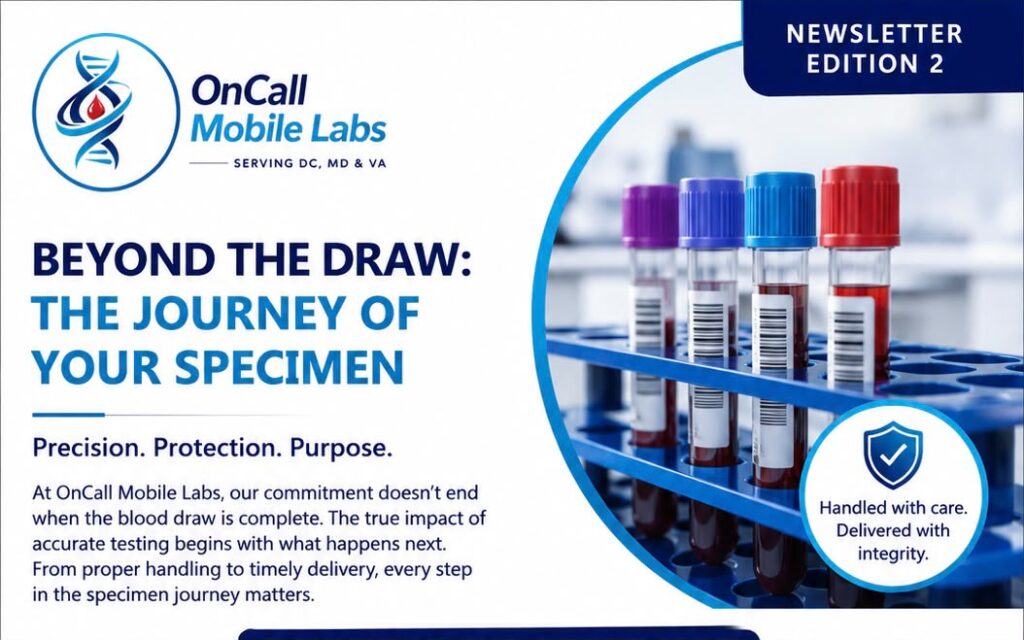
When most people think about phlebotomy, they think about one thing: drawing blood. The needle goes in, the tubes are collected, and the procedure is finished.
But from a laboratory perspective, the blood draw is only one part of the process.
A specimen can be collected successfully and still become unsuitable for testing because of incorrect patient identification, the wrong collection tube, improper processing, delayed separation, incorrect temperature, exposure to light, poor transportation conditions, or other pre-analytical errors.
At OnCall Mobile Labs, we understand that the quality of a laboratory result begins long before the specimen reaches the testing instrument. That is why our responsibility doesn’t end when the blood draw is complete.
We focus on the entire specimen journey—from the patient to the laboratory.
It Starts With Correct Patient Identification
Before a specimen is collected, one of the most important steps is making sure it is being collected from the right patient.
At OnCall Mobile Labs, patient identification is treated as a critical safety step. Appropriate identifiers are verified against the laboratory order and other required documentation before collection.
Specimens are then labeled according to applicable laboratory requirements so they can be accurately associated with the patient and testing ordered.
An accurately collected specimen from the wrong patient is still the wrong specimen. There is no substitute for proper patient identification.
Before We Collect: We Research the Test Requirements
Not every laboratory test is collected or handled the same way.
Before collection, OnCall Mobile Labs reviews the requirements for the ordered tests and the receiving laboratory. Depending on the test, we determine:
- The appropriate specimen type
- The correct collection tube or container
- Required specimen volume
- Whether whole blood, serum, or plasma is required
- Whether centrifugation is necessary
- Whether serum or plasma must be separated from the cells
- Required processing timeframe
- Storage temperature
- Whether the specimen must be protected from light
- Transportation requirements
- Any other test-specific handling instructions
This preparation is especially important because requirements can differ between tests and laboratories. We do not assume that every tube of blood should be treated the same way.
Understanding Whole Blood, Plasma and Serum
Once blood is collected, what happens next depends on the test.
Whole Blood
Some tests require the blood to remain in its original cellular form. These specimens are generally collected into tubes containing an appropriate anticoagulant and are not separated into serum or plasma before testing.
A common example is a complete blood count (CBC), which evaluates blood cells and therefore requires an appropriate whole-blood specimen.
Other tests may also require whole blood depending on the laboratory’s methodology and requirements.
Plasma
For tests requiring plasma, blood is collected into an appropriate anticoagulant tube and then centrifuged. Centrifugation separates the cellular components from the liquid portion of the anticoagulated blood.
The resulting plasma may need to be transferred into an appropriate secondary container depending on the test and receiving laboratory’s instructions.
Serum
Serum specimens are typically collected into tubes that allow the blood to clot before centrifugation. Once appropriately clotted and centrifuged, the serum is separated from the cellular components.
Depending on the test, serum may remain in an appropriate gel-separator tube or may need to be transferred to another container.
Knowing the difference matters. The wrong specimen type can result in an unacceptable specimen or inaccurate testing.
Timing Matters
Specimen processing isn’t something that can always wait until later.
Certain specimens have specific stability windows and must be processed within a defined period after collection. For some tests, this may mean centrifuging and separating serum or plasma from the cellular components within approximately two hours of collection. Other tests may have shorter or longer requirements.
The exact timeframe depends on the test, specimen type, collection system, laboratory methodology, and receiving laboratory’s requirements.
Why does this matter?
Once blood leaves the body, the cells and other components of the specimen continue to undergo biological and chemical changes. Allowing a specimen to remain in contact with cells longer than permitted can affect certain analytes and potentially compromise the quality of the result.
This is why OnCall Mobile Labs reviews the required collection-to-processing and processing-to-delivery timeframes before the appointment whenever applicable.
Some Specimens Need Protection From Light
Light exposure can affect certain analytes and compromise specimen stability.
When a test requires protection from light, the specimen must be appropriately shielded during handling and transportation according to the laboratory’s instructions.
Examples of analytes that may require light protection under specified collection conditions include:
- Bilirubin
- Beta-carotene
- Vitamin A
- Vitamin B6
- Vitamin C
- Porphyrins
Requirements vary by test and laboratory, so OnCall Mobile Labs verifies the applicable handling instructions rather than relying on assumptions.
A specimen can look perfectly normal while having been compromised by improper exposure. Proper handling matters even when the problem cannot be seen.
Temperature Matters Too
Another critical consideration is specimen temperature.
There is no single correct transportation temperature for every laboratory specimen.
Depending on the test, a specimen may need to be:
Maintained at controlled room temperature
Some specimens remain stable at room temperature for a defined period.
Refrigerated
Certain specimens require refrigerated conditions to maintain stability during storage or transportation.
Frozen
Some specialized tests require the specimen to be processed and frozen within a specified timeframe and maintained frozen until it reaches the laboratory.
For certain specialized tests, other temperature-specific handling requirements may apply.
Simply placing every specimen in the same transport cooler is not appropriate specimen management.
Proper Transportation Completes the Journey
After collection and any required processing, the specimen still has to reach the laboratory in the proper condition.
Transportation can be just as important as collection.
Depending on the test, transportation requirements may include:
- Maintaining the required temperature
- Protecting the specimen from light
- Keeping specimens properly contained and packaged
- Preventing leakage or contamination
- Maintaining specimen identification
- Following applicable biohazard transportation procedures
- Meeting stability and delivery timeframes
- Maintaining required documentation or chain of custody
Our goal is not simply to deliver the specimen.
Our goal is to deliver the right specimen, from the right patient, collected in the right container, processed correctly, maintained under the appropriate conditions, and delivered within the required timeframe.
Why This Matters: Preventing Specimen Rejection
One of the biggest misconceptions about phlebotomy is that successful blood collection means the job is complete.
It doesn’t.
A technically successful blood draw can still produce a specimen that the laboratory cannot use.
Common pre-analytical problems can include:
- Incorrect patient identification
- Incorrect or incomplete labeling
- Wrong collection tube
- Insufficient specimen volume
- Improper tube mixing
- Hemolysis
- Clotted specimens when an anticoagulated specimen is required
- Failure to centrifuge when required
- Delayed centrifugation or separation
- Incorrect storage temperature
- Failure to protect a light-sensitive specimen
- Improper transportation
- Exceeding specimen stability requirements
When a specimen is rejected, the consequences go beyond inconvenience. The patient may have to undergo another blood draw. Care may be delayed. Nursing or medical staff must coordinate another collection. The laboratory receives additional work, and everyone loses valuable time.
For vulnerable patients—particularly older adults, children, homebound individuals and patients with difficult venous access—an unnecessary recollection can be especially burdensome.
These are exactly the kinds of problems OnCall Mobile Labs is working to prevent.
More Than Phlebotomy
At OnCall Mobile Labs, we believe professional specimen collection requires an understanding of what happens before, during and after the blood draw.
Our approach is built around laboratory standards—not simply obtaining blood.
For every applicable test, we review the collection and handling requirements so that we understand what must happen to that specimen from the moment it is collected until it is delivered to the receiving laboratory.
That means asking the right questions:
What specimen is required? What tube should be used? Does it need to clot? Does it need to be centrifuged? Does the serum or plasma need to be separated? How quickly must that happen? Should it remain at room temperature, be refrigerated, or be frozen? Does it need protection from light? How quickly must it reach the laboratory?
Those details matter.
The OnCall Mobile Labs Standard
Every specimen represents a patient waiting for an answer.
That is why our responsibility doesn’t end with a successful venipuncture.
From patient identification → collection → processing → handling → storage → transportation → laboratory delivery, we approach each step with the understanding that specimen quality directly affects the quality and reliability of laboratory testing.
OnCall Mobile Labs is here to raise the standard of mobile specimen collection—because drawing the blood is only the beginning.
OnCall Mobile Labs
Professional Mobile Phlebotomy & Specimen Collection
Serving Northern Virginia, Washington, DC, and Maryland
Phone: 703-452-2425
Email: info@oncallmobilelabs.com
Website: oncallmobilelabs.com